
Essays · September 2026
Corporate Meeting Survival Guide
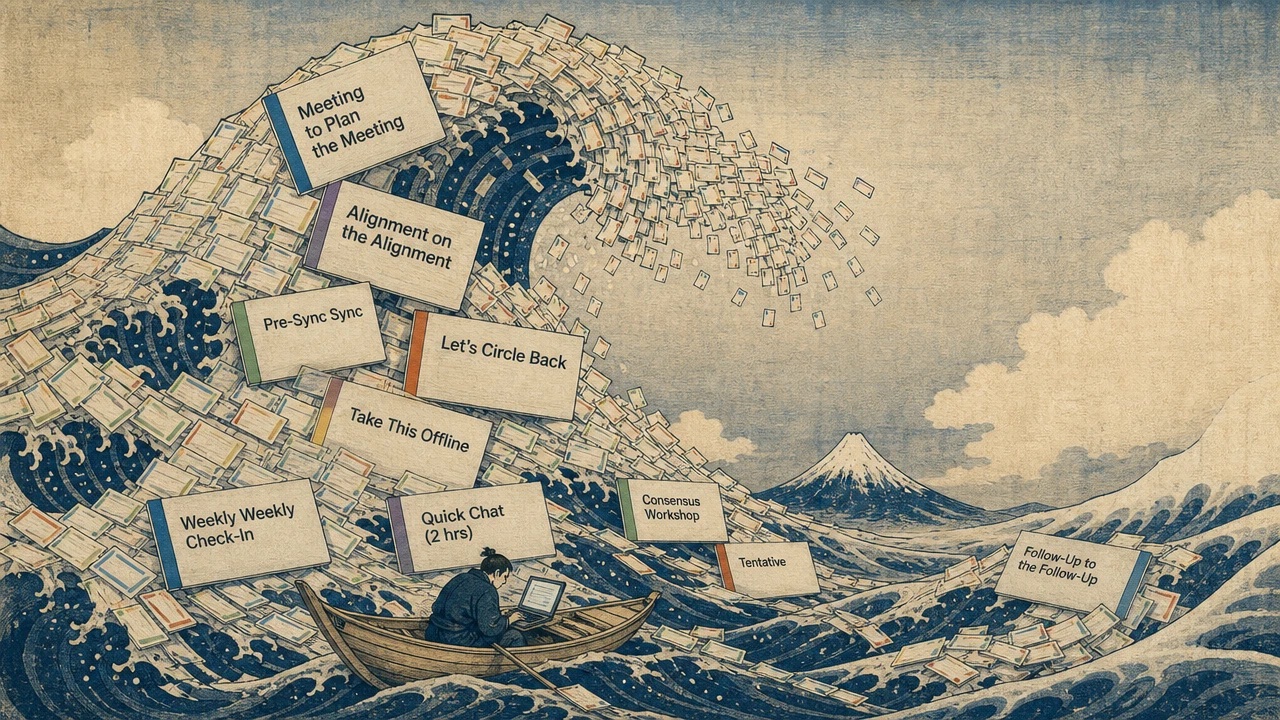
The funniest thing about going from startups to a big company is the meetings. The sheer volume of them. I have worked at a company where the entire team sat in one room, and now I work at one where the entire team sits in one Teams window. It's amazing anything gets done! Of course it does, but at what cost?
In a startup, you turn around and ask someone. Or you don't, and you write it down, and they answer when they answer. That's the whole system. It's sometimes called working asynchronously. People would actually say "let's work on that async." I have never heard that said in a larger company.
In a corporation, everything is an orchestration. And usually with the size of an orchestra. Fourteen faces in a grid, two of them on mute forever, and then there's me staring blankly at myself wondering if I need a haircut. Truthfully I'm often wondering if I need to be sitting in this meeting at all. It's a difficult balance to maintain because too few meetings and information is not flowing throughout the org. However, too many meetings means nothing is getting done, which can create even more meetings to figure out why.
The best part of large meetings is what happens when an actual decision needs to be made. This is the pivotal moment. Everyone is here. Someone could just say yes. Instead someone says "let's circle back." Or "let's take this offline." The one time the work could happen, the work is postponed, and it goes off to become a series of new meetings, each of which will end the same way. It's a fractal.
On top of that I work in Scandinavia, a region that prides itself on meetings and consensus. So you sometimes find yourself in a meeting to plan a future meeting. Meetings to align on the alignment from a previous meeting. My Swedish colleagues have more meetings than IKEA has pieces, and you have to assemble every one of them yourself. My Norwegian colleagues just agree to everything in meetings. The Danes are great when it comes to meetings and making decisions. If you've never been in a Danish meeting, imagine a meeting, but it ends.
What I've been testing
I have been running some experiments on corporate meeting life. If you are a colleague of mine, I kindly ask you to stop reading here. Or keep reading to better understand why I am the way I am.
RSVP tentative to everything. Keep them guessing. If you show up, it's a happy surprise! If you don't, because you have actual work to do, you set the correct expectation from the start. Tentative is a beautiful word. It means "I love you, but no."
Then just decline. Meetings you don't want to attend, with people you don't want to meet. Eventually they get the hint and stop inviting you altogether. This sounds rude and it is, but it's also the only meeting hygiene that works at scale, and it is significantly less rude than sitting there with your camera off doing something else, which is what everyone else is doing.
Set every recurring meeting to end soon. Someone proposes a weekly. Fine. Set it to end in a few weeks. Don't say anything when it stops. See if anyone notices. If they don't, you didn't need it. Or the topic died and nobody told the calendar. Most recurring meetings are just a topic that died and nobody told the calendar.
Never do one-on-ones. Brian Chesky, CEO at Airbnb, has a whole thing on why he stopped doing them, and he's right. They turn into therapy. The employee never brings up what the boss wants to talk about, and mostly they complain about a colleague they should have just gone and talked to directly. I meet my team for 30 minutes a week, all together, and that's enough. They can only take my long-winded rants for so long, and I have only so much patience for their complaints.
Just call me! Finally, and perhaps the most impactful thing one can do to reduce meetings is just call someone. Don't announce it. Don't do the "are you available between 1:12 and 1:43 on Tuesday" shuffle. Just call them. I work with about 200 people and only 2 people do this to me. One is my boss, and the other is French. Be more French!
The point
None of this is about hating meetings. Some meetings are good. The Danish ones, mostly.
It's that a big company will fill every hour you give it, and it will fill it with people describing work to each other. You have to protect the hours where the work actually happens, and nobody is going to do that for you. Nobody is going to circle back to your calendar and take some of it offline.
So decline the invite. If it mattered, they'll schedule a meeting about it.