Essays · November 2026
The Factory of the Future Is a Mac Mini on My Desk
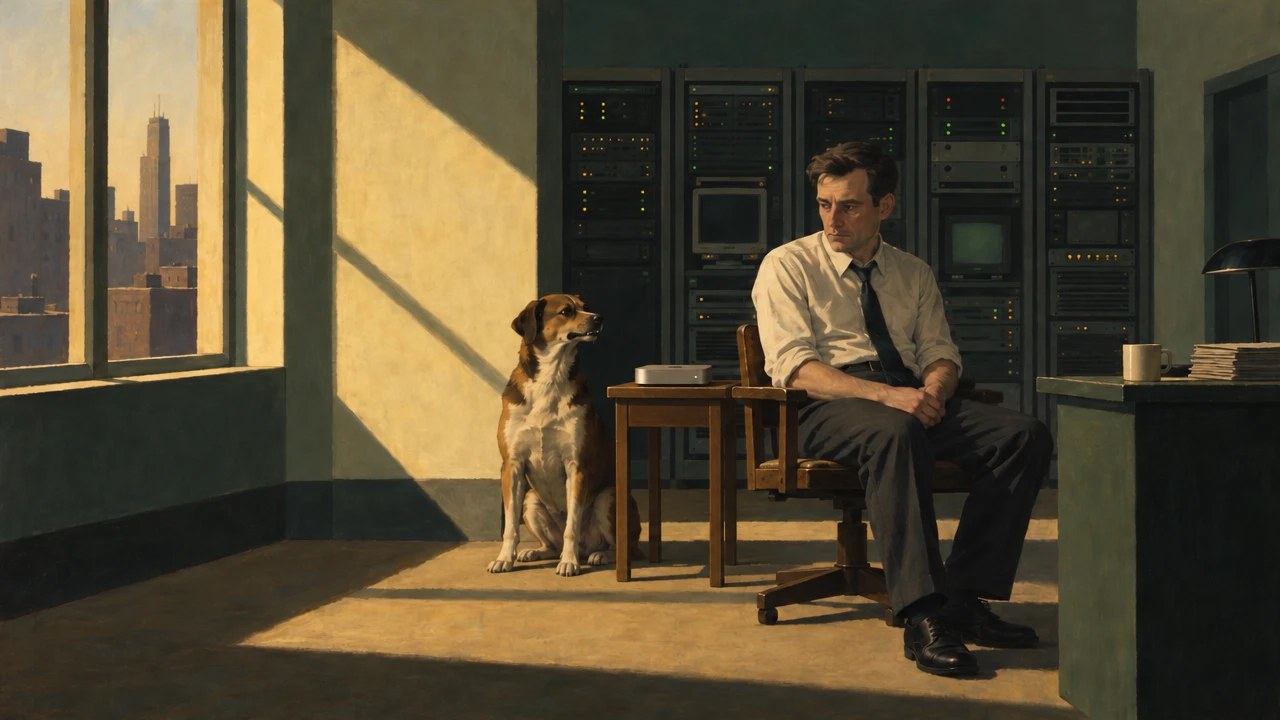
There's an old line about the factory of the future. It will have two employees, a man and a dog. The man is there to feed the dog. The dog is there to keep the man from touching the machines.
I recently decided to leave my job after three wonderful years. The decision to leave took months. The first thought after making it took about four seconds.
What happens to my AI automations.
The dog
Over the last year I've built a lot of them. I've lost track of how many. Simple things like the weekly sales report that writes itself. More complex things that make various systems talk with one another. Some are reliable. Some work until a login expires, which is roughly every ninety days, which is a feeling I now have in my body.
Most of them run on a Mac Mini. Not a server. A Mac Mini, on my desk at the office, running a patchwork of MCPs and skills I wrote when something annoyed me enough. It's the only machine in the building that nobody else can log into and several people depend on. Half the data connections use my work login. The other half use my personal accounts because the work ones didn't have API access or IT said no.
So the factory of the future exists. I built it. It has one employee and a dog, and the dog is me.
The part that used to be easy
When I left jobs before, the handover was boring, which is the highest compliment you can pay a handover. The website was on a hosting account the company owned. The code was in a repo the company owned. There was a Confluence page nobody read, but it existed. The next person logged in, swore at my naming conventions, and carried on.
That worked because the web spent twenty years building conventions for it. Git. Staging environments. Documentation templates. Offboarding checklists with a line that says “knowledge transfer.” Somebody, somewhere, got burned badly enough to write that line.
The AI automation stack has none of it. Not because the tools are bad. Because they're new and everyone building with them is a department of one. Me and the dog.
What doesn't transfer
An honest inventory of what my successor gets:
The workflows, technically. They were built with tokens the company paid for, after all. They can see them. They can't read them, because the logic is in my head and the prompts are written in a shorthand that only makes sense if you were there when the thing broke the first time. A Claude memory that says “ignore the Danish data, you know why” is not documentation.
The credentials, sort of. The ones tied to work accounts get revoked the day I leave, which is correct and also kills six things nobody knew were running on them. The ones tied to my personal accounts keep running, silently, from a desk I no longer sit at, which is arguably worse.
The Mac Mini, yes. It stays on the desk. Nobody knows the password.
And none of this is the company's fault. It's mine. I built a factory with no floor plan because building it was faster than explaining it, and because every time I tried to explain it, somebody asked about the font on the report.
SaaS
So I have a proposal, and I'm only about 60% joking.
Keep the Mac Mini on. Don't let IT image it. Pay me a small monthly fee to maintain it. When a data connection drops or a login expires or Claude decides a Swedish postcode is a phone number, I log in remotely and fix it. Call it SaaS. Sean as a Service. One tier, no dashboard, cancel anytime, don't touch the machine. The old ones keep running. New ones get built on top.
This is a stupid idea and it is also exactly how a lot of companies are going to run for the next few years. Not with me. With whoever their version of me is. The person who got excited early, wired everything together, and is now a single point of failure with a Netflix password.
I've floated this. Loosely. I'll report back if they take me up on it and I manage to turn myself into MRR.
My take
The old handover worked because the work lived in places the company owned. The new work lives in places the builder owns. Their laptop, their accounts, their head. We've recreated the key man problem, except the key man doesn't know he's one, and the company doesn't know it has one, until someone gives notice and a report stops showing up on a Monday.
VCs make founders buy key man insurance. Nobody's writing a policy on the AI automation guy with the Mac Mini.
The offboarding checklist for this doesn't exist yet either. I'd start it with one line: list every automation that would stop if you died. Then list every one that wouldn't, and ask why.
I'll be writing mine over the next few weeks. Floor plan, credentials, which prompts have jokes in them that are actually load-bearing. The factory of the future will get its two employees eventually.
The man still feeds the dog. Nobody has figured out who feeds the Mac Mini.
P.S. I'm writing a book next about how AI is changing (or not changing) work. If you have an opinion on this, or a Mac Mini of your own, I want to interview you. Get in touch here or email me@seanpercival.com. I will also need a new job at some point, if you would like to hire me, or my Mac Mini.