
Essays · October 2026
Will Agencies Survive the Agentic Era?
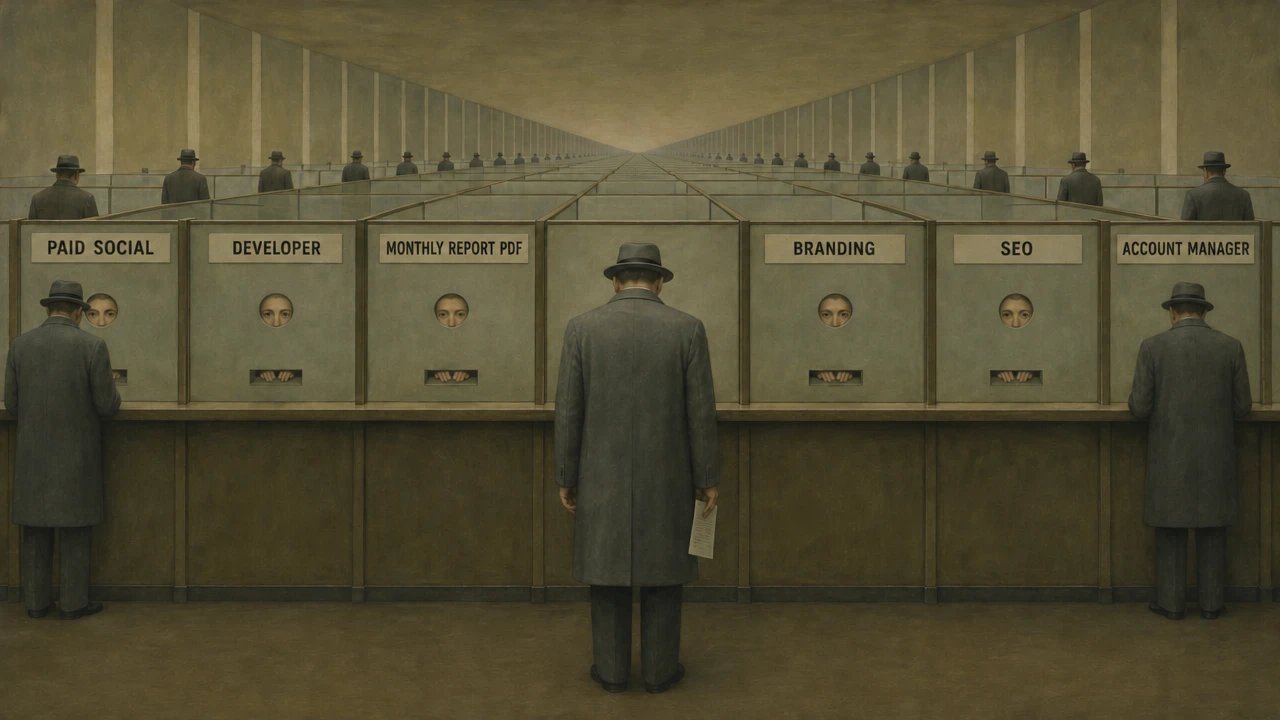
In Norway we use a lot of agencies.
Marketing agency, ad agency, design agency, developer agency, branding agency, the agency that manages the other agencies. It goes on.
It makes sense here for two reasons. Hiring in Norway is slow, and firing is somewhere between expensive and theoretical. So when you need capacity to go up or down, an agency is the only dial that actually turns. The other reason is the one agencies put in their decks, and it's also true: fresh eyes. Inside a company of any size you get tunnel vision. Somebody from outside walks in, looks at the thing for two minutes, and asks why the checkout button is grey.
So agencies are a workaround for a labor market and a cure for your own blind spots. Both good reasons to exist. Neither is guaranteed to survive the next couple of years.
The word everyone is using and nobody agrees on
Agentic is a loaded word now. Ask five people and you get five definitions. Strip it down and it means this: more of the work runs without a person in the loop, and the person moves from doing the thing to checking the thing.
I've had a lot of conversations with agencies this year. Our own, other people's, the ones pitching me, good ones, and a few bad ones. Nearly all of them say they use AI because of course they do. Saying you don't these days would be like a Norwegian saying they don't ski. People will be polite about it and then never fully trust you again.
Nearly all of them, when you look at how the work actually gets done, do it the way they did in 2022. One dedicated social person. One dedicated designer. A monthly PDF built in Looker Studio off Google Analytics, with a slide that says impressions are up 12% and no slide that says what to do about it. Campaigns set up by hand, by someone, one at a time.
Artisanal marketing. Small batch. Locally sourced. Hand-poured. Each Meta campaign lovingly crafted by a junior in Grünerløkka using a recipe passed down from a senior who learned it in 2019. Farm to Looker Studio. (Apologies for the hyper-local marketing jokes that maybe three people will get.)
Handmade is wonderful when you want a pair of shoes. You pay for the hours because the hours are the point, and in thirty years your kid inherits them. Nobody inherits a retargeting audience. Not even my kids. They want my Fortnite account, which holds roughly a year of college tuition in skins.
I don't say this to dunk on agencies. Especially the ones I'm paying and generally very happy with (please don't fire us as a client). Their structure is what makes it hard. The billing is headcount. The org chart is headcount. And this is Norway, so the headcount can't be un-hired. You cannot easily automate a job you are legally committed to keeping.
The part I'll defend
The shoes still matter, though. This is where I'll defend the agencies, briefly, before going back to being annoying.
The best agencies I've worked with have never shown me a dashboard. They show up with a question I hadn't thought to ask, I spend the next week annoyed about it, and they're right. That's the part worth paying for. Not the deliverable, the argument before the deliverable. Someone who pushes back on the brief, tells me the thing I'm sure about is wrong, and makes me explain myself until I either change my mind or finally understand why I hold it. I walk out of those meetings having learned something, and when that happens I stop reading the invoice.
Claude doesn't do that. It gives me 40 variations in a minute and cheerfully tells me all 40 are strong. Taste is knowing which one is the one before the test runs, and taste comes with opinions attached.
Taste is also the one thing we haven't managed to agentify, and I've tried, and the results were slop with good kerning. The agencies that have it should charge more for it than they do. Most of them bill it at the same hourly rate as the campaign setup, which is how you know they don't realize what they're sitting on.
The printout
The uncomfortable part is that I've started using my own agents to check the agencies. That's where things get a little awkward for us both. First, because it very quickly points out the human-made errors. In the marketing world that's things like bad targeting, wrong URLs, etc. Then comes the next problem: telling them you found it with Claude. The words are tainted before they even finish leaving your tongue.
It's the same feeling as walking into the doctor's office with the diagnosis already printed out. You had a five-minute chat with Claude the night before. You're fairly sure it's the thyroid. You slide the printout across the desk and say, "what do you think?" The doctor has spent eleven years learning to answer that question, and now has to decide whether to argue with a PDF or just bill you.
The thing is, the printout is sometimes right. That's the whole problem. The doctor who's worth keeping is the one who looks at it and says "close, but you missed this," and then shows you the thing you couldn't have found on your own. The one who gets defensive about the printout is the one you should worry about. You already know which kind your agency is. You found out the first time you mentioned Claude in a meeting and watched the face.
The numbers already moved
This isn't a Norwegian problem waiting to happen. It already happened at the top of the industry, it just hasn't reached Norway yet. Things often take a bit longer to get here. We didn't really get spice until the 90s, for example, and we're still figuring that whole thing out.
Forrester's 2026 agency prediction is titled, with no subtlety, "Marketing Agencies Resign Their Agency." Their read: agencies cut around 8% of headcount in 2025 and will cut another 15% in 2026, and the ones that survive stop selling hours and start owning and reselling products.
And on the client side, a CMO at a gym chain in Dubai wrote a public confession this June about dropping his creative, PR, paid, SEO and content agencies for in-house AI. His one admission: he underestimated how long the build takes. Which is the part nobody puts in the LinkedIn post. Myself included.
What the survivors will probably look like
Billing has to move. Hours were already a bad idea. Billing a percentage of media spend made sense when setting up the media was hard. It isn't hard anymore. Bill for what you built.
Which means agencies have to build something. Their own systems. An agentic flow that monitors every client's Klaviyo deliverability and flags the drop before the client's agent does. An MCP server for their reporting that a client can plug into their own Claude. A creative pipeline that's actually a pipeline. Things built once and sold to one client, then ten. Software margins on a services business, which is the only way the math works when the client's capacity to do it themselves keeps going up.
Most of what I'd want from an agency today, I'm building internally, in the gaps, because nobody offers it and I didn't want to open another retainer to find out. That gap is the product. The agencies that notice it first get to sell it. The rest get to find out what their retainer was actually for.
I'd like to be wrong about the ecosystem here. It's not moving at the speed the moment requires. The retainers are comfortable. The laurels are being rested on. The two forces squeezing them, tools getting easier and companies automating more, are not waiting for anyone's org chart.
Charge me for the taste, and the tools. I'll stop bringing the printout.